Caitlin Clark earns $527K from the WNBA this season. She earns $16M from endorsements. The league salary was never the point.
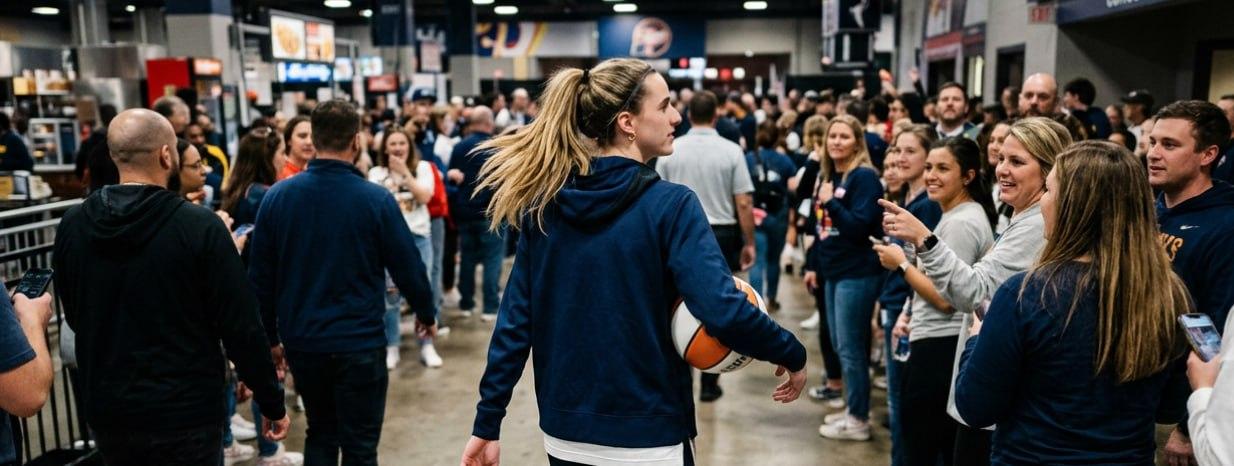
In 2025, Caitlin Clark earned $78,066 from the Indiana Fever. She earned $16 million from endorsements. Her WNBA salary represented roughly 0.5% of her total income.
This year, under the new collective bargaining agreement, her league salary jumped to $527,155. That is a meaningful increase, the result of years of advocacy by WNBA players and a landmark new CBA that for the first time introduced the EPIC provision, allowing elite performers to reach maximum pay on their rookie contracts.
It is still roughly 3% of what she earns off the court.
The Caitlin Clark economy has almost nothing to do with what the WNBA pays her.
The numbers
Clark was the first overall pick in the 2024 WNBA Draft. Her four-year rookie contract with the Fever was worth $338,056 in total. The structure was not unique to her. Every WNBA rookie was subject to the same scale regardless of what they generated for the league.
What Clark generated for the league was extraordinary. Games she played in became the most-watched women's basketball events in decades. Ticket prices for Fever games rose across the league. The WNBA's overall viewership and attendance figures moved in ways directly attributable to her presence.
The endorsement market noticed what the salary structure could not reflect. Nike signed her to an eight-year, $28 million deal in April 2024, the largest endorsement contract ever given to a women's basketball player at signing. It pays approximately $3.5 million annually and includes her own signature shoe line, the Caitlin 1, which sold out immediately upon release. She also holds partnerships with Gatorade, State Farm, Wilson, Xfinity, Gainbridge, and Panini. Sportico estimated her total 2025 earnings at $16.1 million, with $16 million coming from sponsorships alone. The WNBA salary and bonuses combined in 2025 added up to approximately $114,000.
What the new CBA changed and what it did not
The new collective bargaining agreement is the most significant improvement to WNBA player compensation in the league's history. The salary cap increased to $7 million per team. Minimum salaries rose substantially, with players at zero years of experience now guaranteed $270,000, up from figures in the $70,000 to $80,000 range under the previous structure.
The EPIC provision was the most consequential new mechanism. Clark, having earned All-WNBA honors, qualified. Her salary moved from $78,066 to $527,155 in a single year. She could earn $1.3 million under a max deal in 2027 and $1.7 million in a supermax in 2028.
These are real gains. Players who fought for this CBA deserve credit for moving an industry that has historically resisted paying its athletes fairly.
The WNBA maximum salary in 2028 will be $1.7 million. The NBA minimum salary in 2026 is approximately $1.1 million. The gap between the ceiling of one league and the floor of the other is narrowing, but it has not closed.
Angel Reese and what the CBA could not fix
Clark's 2026 salary is $527,155. Reese, under the same agreement, moves to $349,571. Clark could reach a $1.7 million supermax by 2028. Reese's path to that figure depends on whether she earns All-WNBA honors in the current season.
Reese's off-court earnings are substantial in their own right. She has a signature Reebok shoe deal, partnerships with Hershey's, Beats by Dre, PlayStation, and Cash App, and has expanded into fashion and lifestyle brand work. Her estimated net worth is around $7 million, a figure that reflects her commercial value independent of her WNBA salary.
But the gap between what Clark earns from endorsements and what the WNBA's new maximum allows tells you something important about where value in women's basketball actually lives.
The structural insight the Clark model reveals
Caitlin Clark is the clearest current example in professional sport of an athlete whose direct audience value has completely outpaced any league's ability to compensate her through salary.
The WNBA did not fail to pay her. It paid her what the salary structure allowed. The market paid her what her audience was actually worth. Those two numbers were $78,066 and $16 million in the same year.
Athletes who build direct relationships with audiences create commercial value that the league salary structure cannot fully capture. The players who earn well beyond their contracts are the ones whose audience relationships generate income independently of what the team or the league pays them.
Clark built that relationship through four years of college basketball, a scoring record that rewrote the history of the sport, and a personality that translated across audiences who had never watched a WNBA game. Nike saw it before the Fever's salary structure could reflect it.
The new CBA is a meaningful step. But the ceiling of $1.7 million in 2028 against $16 million in current endorsement income illustrates that the salary structure will always lag the market when an athlete's audience value is extraordinary.
The league salary was never the point. It was the starting point.
Join the Thravos movement
Join the Thravos revolution! We’re building a vibrant community where everyone is welcome. Bring your friends, family, and even your neighbors! Together, we can create a healthier and happier future.
Get started today!
Follow us on social media: Stay connected with the latest news and updates on Twitter, Discord, and Telegram.
Disclaimer: This post may include forward-looking statements based on current expectations, plans, or projections. Actual results may differ due to various factors beyond our control. Readers are encouraged to conduct their own research and use independent judgment when interpreting the information provided. All content is for informational purposes only and should not be considered professional advice.