NFL training camp is underway. The players who can't afford to hold out are the ones nobody talks about.
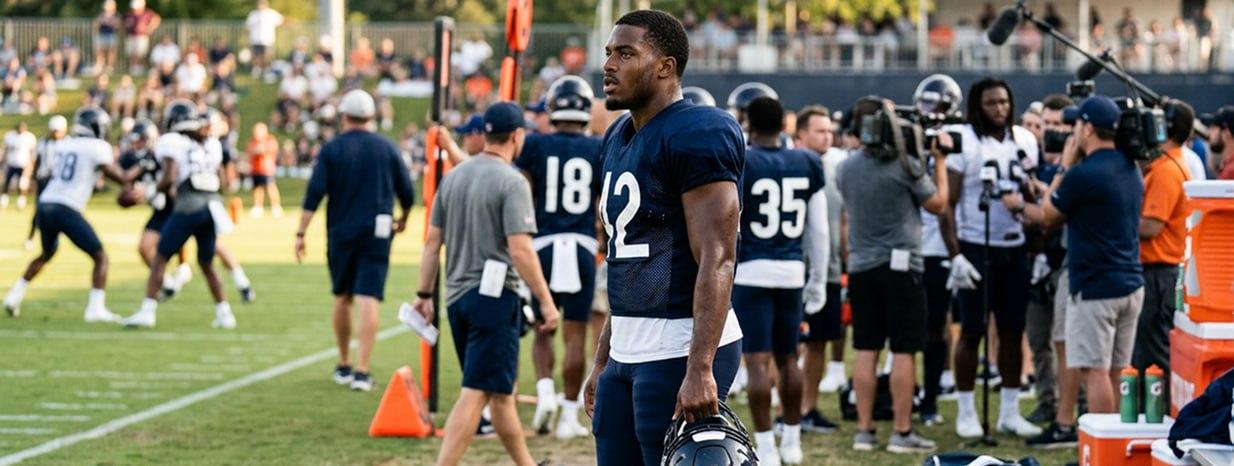
Bijan Robinson just ended his hold-in at Atlanta Falcons training camp. The running back skipped practices, avoided fines by reporting to the facility, and waited. The result: a three-year extension worth up to $75 million, with $51 million guaranteed, making him the highest-paid running back in NFL history.
Baker Mayfield is telling reporters he feels disrespected by the Buccaneers after failed contract negotiations. Jahmyr Gibbs posted a vague Instagram that set off a news cycle about his contract situation in Detroit. The Saints just signed Chris Olave to a four-year, $132 million extension.
This is training camp season in the NFL. Every week, a star player applies leverage and gets paid. It is one of the most visible annual rituals in professional sport.
The athletes this coverage never reaches are the ones fighting for the 53rd roster spot. They have no leverage. No hold-in produces a headline when the alternative is not a renegotiation but a cut slip.
How holdouts actually work
An NFL holdout happens when a player under contract refuses to report to training camp in order to force a renegotiation. Under the current collective bargaining agreement, players who hold out face fines of $50,000 per day. Players on rookie contracts face $40,000 per day.
Hold-ins are a softer version of the same strategy. The player reports to the facility to avoid fines but skips practice, staying visible enough to avoid penalty while still applying pressure. Multiple players are currently doing this across league camps.
The mechanism only works if you have something to negotiate from. Robinson held in because the Falcons needed him, could not easily replace him, and because the market would have paid for him elsewhere. For a player on the roster bubble, none of those conditions exist.
What the 53rd spot actually looks like
Every NFL team carries 90 players into training camp and cuts to 53 by the roster deadline on August 26. Roughly 1,200 players across the league will be released in a single afternoon.
Those players trained all offseason. They are at camp right now, running routes and taking hits alongside the players signing $75 million extensions. The difference is that they entered camp without a guaranteed contract, fighting for a roster spot that may not exist when the deadline arrives.
If they make the 53-man roster, they earn the NFL minimum salary, which starts at $885,000 for rookies in 2026 and rises to $1,005,000 for veterans.
If they do not make the 53-man roster, they may sign to a practice squad. The standard practice squad salary in 2026 is $13,750 per week for players with two or fewer seasons of experience, roughly $247,500 for the full 18-week regular season. They practice with the team every day, travel to road games, and dress in street clothes on game day unless elevated. They can be released at any point during the season with no further obligation from the team.
If they clear waivers and go unsigned entirely, they earn nothing.
The leverage gap
The holdout is the only formal leverage mechanism available to NFL players outside of collective bargaining. It works because the player has something the team wants and the market will pay for.
A player competing for the 53rd roster spot has none of those conditions. The team is evaluating whether to keep them at all. Holding out would simply make the decision easier.
The NFL salary cap sits at over $300 million per team in 2026, more than double what it was a decade ago. The holdout headlines this week involve players negotiating over where their compensation sits within that growing pool. The players who will be cut on August 26 participated in generating the preseason value that supports it. They received no guarantee that any of it would reach them past that date.
What happens after the cut
The NFL is unusual among major professional sports leagues in that the majority of its contracts are not fully guaranteed. An NBA player signed to a four-year deal is owed that money barring specific contractual carve-outs. An NFL player signed to an equivalent deal can be cut before the guaranteed portion runs out.
For players on the roster bubble, there is often no guaranteed money at all.
The practice squad provides a partial safety net. Sixteen spots per team, paid weekly, with no long-term obligation from either side. A player can be elevated for a game and return to the practice squad. They can be signed away by another team. They can be released on a Wednesday with no further income.
The question nobody asks during camp season
NFL training camp coverage is overwhelmingly about the players who have leverage. The holdouts, the extensions, the disrespected veterans forcing renegotiations. That coverage is accurate and the stories are real.
The gap is in what gets left out. The athletes who train at the same level, generate value for the same teams, and have no mechanism to participate in the economics of what they produce because the system is not designed to give them one.
Bijan Robinson has leverage because he is irreplaceable. The player competing for the 53rd spot is, by definition, replaceable. That replaceability is the entire financial logic of how the roster bubble works.
But replaceability at the roster level does not mean the athlete has no value, no audience, and no relationship with fans. It means the team has options. The athlete still has a story, a following, and a competitive career that generates real engagement from real people who care about what they do.
The holdout gets the coverage. The player who cannot afford one is still there, in the same camp, doing the same work. Training full time. Building an audience of fans who follow their journey, their progress, their career. With no mechanism to earn from any of it.
That is the gap platforms like Thravos are built to close. Not for the Bijan Robinsons negotiating their second extensions, but for the athletes on the roster bubble and below it, the ones competing seriously, building real followings, and producing value that the team salary structure will never fully capture. Direct fan relationships, subscription channels, coaching, community. Income that does not depend on making the 53-man roster.
The leverage gap in the NFL is structural and it is not going away. What can change is whether athletes at every level have a way to earn from what they have already built, regardless of what happens on August 26.
Join the Thravos movement
Join the Thravos revolution! We’re building a vibrant community where everyone is welcome. Bring your friends, family, and even your neighbors! Together, we can create a healthier and happier future.
Get started today!
Follow us on social media: Stay connected with the latest news and updates on Twitter, Discord, and Telegram.
Disclaimer: This post may include forward-looking statements based on current expectations, plans, or projections. Actual results may differ due to various factors beyond our control. Readers are encouraged to conduct their own research and use independent judgment when interpreting the information provided. All content is for informational purposes only and should not be considered professional advice.